Contribute to the Physical, Mental and Spiritual Development of the Tanzania people through facilitating the Provision of Quality Social Services to all the people regardless of Colour, Race and Creed

Tuesday, November 5, 2013

Owners Meeting

This meeting was held in Mwanza city on 30,October 2013 at Monarch Hotel
Objectives of the meeting were:
1. Putting together all Owners and In charges of the supported facilities to share experiences, best practices and challenges encountered during the program implementation in COP12
2. Setting a jointly way forward for implementation in COP13

Participants:
RMO and RHMT Mwanza, Zonal TB/HIV coordinator, RACC Mara, Health Secretaries/Director of Health, City director/DEDs, CMO, DMOs, DACCs, DLTs, DPharmacists, DRCHCo, District TB/HIV officers, Facility in charges/Hospital director, CTC in charges, CTC coordinators and DBS focal person

Ukerewe DMO Dr. Mattaka chit chatting with the ART Program Regional coordinator Dr. Bendela

Mwanza Regional AIDS Control Coordinator (RACC) giving a presentation on                                                       HIV/AIDS Overview in Mwanza

Dr. Sekule-ART Program manager

CSSC Director of Health services following attentively

A section of participants following a presentation by ART Program Manager (not in the picture).

Meeting facilitator Dr. Makata

ART Program Manager presenting program performance for the fiscal year 2013


Dr. Nyanza-Medical Officer Incharge from Mkula AICT Hospital following close the presentation

Moderator perusing the meeting schedule


ART staffs following the presentation

ART staffs following the presentation

Participants at the Owners Meeting held at Monarch Hotel, Mwanza

Participants at the Owners Meeting held at Monarch Hotel, Mwanza

Participants at the Owners Meeting held at Monarch Hotel, Mwanza

Sunday, October 6, 2013

PMTCT Option B+


PMTCT Option B+, which is a newly adopted approach in the country of initiating all the pregnant women Antiretroviral Therapy for the aim of eliminating HIV transmission from Mother to Child. As it stand the current proportional rate of transmission from mother to child is 26% and we aim to reduce it up to 4% by 2015.The training was held at Nyakahoja and 91 participants were involved from 40 facilities of Mwanza. The participants divided into three classes of thirty. The training run for five days from yesterday till Friday.


A trainer marking Pretest for 2nd week participants


CSSC ART Regional Coordinator


Dr. Mbwele addressing something


Participants listening


The Guest of Honor Mwanza RACC Dr. Maselle during Closing Session


Second week: a trainer handling the issues


Dr. Mbwele welcoming the Guest of Honor
Dr. Pius Maselle addressing participants


The Guest of Honor giving a speecch


Day two of second week on progress


RAAC Mwanza Dr. Maselle leaving after closing ceremony


Day 5 of 2nd week on progress


Trainer facilitating

Tuesday, September 24, 2013

Viewer's Profile

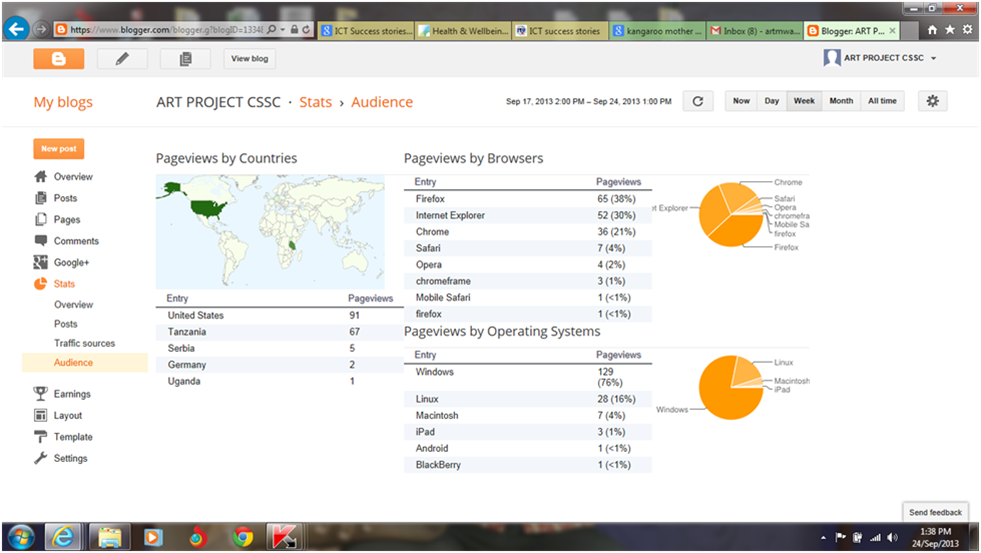
We want to thank you for giving your time to visit our blog and give your comments. This is our statistics as at  September 17th 2013 to 24th September 2013. We are proud of you and in any case don't hesitate just communicate with us through artmwanza@gmail.com or afrancis@cssc.or.tz and we guarantee you that your views and ideas shall add the value of this site.
 

Monday, September 23, 2013

Success Story from South Africa


Access to performance-based funding from the Global Fund to fight AIDS, Tuberculosis and Malaria, has enabled the Western Cape Province to race ahead with its antiretroviral (ARV) rollout. As of 2005, The Global Fund’s contribution helped enable the province to provide antiretroviral treatment to 65% of those people who desperately need it (a figure in stark contrast to the then South African national average of 10%). This paper illustrates how the Global Fund grant, in its first year, clearly met and in some cases, exceeded its targets particularly in relation to ARV treatment.


Based on the research carried out as part of the preparation for this paper, it becomes clear that the Western Cape’s progressive and committed management team was a key contributing factor in successfully providing increased access to medical treatment. Other factors that have contributed to the success of the grant project include: the fact that in 1999, the province first initiated provision of ARV drugs to help prevent HIV-positive women transmitting the infection to their infants; and the experiences gained from both the introduction of treatment drugs and from the three-year ARV rollout projects in Khayelitsha and Gugulethu. This paper discusses the factors that have contributed to the success of the Western Cape ARV treatment programme and how, through funding from the Global Fund grant and other national funds, a foundation has been created for a successful programme.

More than 40 million people worldwide are HIV-positive and since AIDS was first discovered, more than 25 million people have died as a result of the disease. Antiretroviral treatment is widely available in developed countries, while access to antiretrovirals (ARVs) in poorer countries has been historically inadequate. The World Health Organisation estimated in 2005 that out of the 6 million people needing life saving medication, only 1 million people are receiving the drugs (WHO, 2005).

This access to life prolonging ARV treatment has caused much controversy in South Africa. With more than 5.2 million South Africans affected with HIV/AIDS, South Africa is the country with the highest number of people infected in the world, and AIDS is the country’s number one killer (Dorrington et al, 2001). The arrival of highly active antiretroviral treatment (HAART) has given hope to millions of people living with HIV/AIDS; however access and commitment from the South African government to provide the life saving drugs has been limited.

The Provincial Department of Health in the Western Cape was the first to start providing HAART in South Africa. As funds for HAART in South Africa were limited, the department applied for external funding from the Global Fund to fight AIDS, Tuberculosis and Malaria in 2003. The proposal was successful, allowing the Western Cape to scale up its HAART programme. This has resulted in the Western Cape rollout being hailed as the ARV success story of the country, with more than 11 000 people living with HIV/AIDS receiving ARV treatment in July 2005, a quarter of whom are funded by the Global Fund. It was further estimated that, at the end of 2005, 65% of those in need of ARV treatment in Western Cape would have access to the lifesaving drugs, a figure considerably higher than the South African national average of 10% (Herman, 2006).

This paper explores and demonstrates the success of the HAART rollout in the Western Cape supported and enabled by the Global Fund.
Visit: http://www.sarpn.org or Communicate with Us to send you this Paper

Success Story from Uganda

HIV prevalence rate among 13-19 year olds in Masaka, Uganda

Source: http://www.who.int/inf-new/aids2.htm


Uganda reverses the tide of HIV/AIDS
 
Uganda's success in reducing high HIV infection rates is the result of high-level political commitment to HIV prevention and care, involving a wide range of partners and all sectors of society. Same-day results for HIV tests and social marketing of condoms and self-treatment kits for sexually transmitted infections, backed up by sex education programmes, have helped reduce very high HIV infection rates.

Uganda, one of the first countries in sub-Saharan Africa to experience the devastating impact of HIV/AIDS and to take action to control the epidemic, is one of the rare success stories in a region that has been ravaged by the HIV/AIDS epidemic. While the rate of new infections continues to increase in most countries in sub-Saharan Africa, Uganda has succeeded in lowering its very high infection rates. Since 1993, HIV infection rates among pregnant women, a key indicator of the progress of the epidemic, have been more than halved in some areas and infection rates among men seeking treatment for sexually transmitted infections have dropped by over a third.

In the capital city Kampala, the level of HIV infection among pregnant women attending antenatal clinics fell from 31% in 1993 to 14% by 1998. Meanwhile, outside Kampala, infection rates among pregnant women under 20 dropped from 21% in 1990 to 8% in 1998. Elsewhere, among men attending STI clinics, HIV infection rates fell from 46% in 1992 to 30% in 1998.
Success in reducing the prevalence of HIV in Uganda is the result of a broad-based national effort backed up by firm political commitment, including the personal involvement of the head of state, President Yoweri Museveni. From the outset, the government involved religious and traditional leaders, community groups, NGOs, and all sectors of society, forging a consensus around the need to contain the escalating spread of HIV and provide care and support for those affected.

Sex education programmes in schools and on the radio focused on the need to negotiate safe sex and encouraged teenagers to delay the age at which they first have sex. Since 1990, a USAID-funded scheme to increase condom use through social marketing of condoms has boosted condom use from 7% nationwide to over 50% in rural areas and over 85% in urban areas. The social marketing scheme involved sales of condoms at subsidized prices or free distribution by both the government and the private sector. The scheme was also backed up by health education and other public information. Meanwhile more teenage girls reported condom use than any other age group -- a trend reflected in falling infection rates among 13-19 year old girls in Masaka, in rural Uganda. And among 15-year-old boys and girls, the proportion who had never had sex rose from about 20% to 50% between 1989 and 1995.

Condom use is also being encouraged among men who seek treatment for sexually transmitted infections. A new innovative social marketing scheme to promote the use of an STI self-treatment kit ("Clear Seven") has proved to be successful in treating STIs and preventing HIV infection. The kit, which contains a 14-day course of tablets, condoms, partner referral cards, and an information leaflet, is designed to improve STI treatment rates, prevent over-the-counter sales of inappropriate treatments, encourage partner referral, and reinforce condom use. The distribution system relies on the use of small retail outlets which are normally licensed to sell over-the-counter drugs but not antibiotics. The Ugandan Government has waived these restrictions to promote sales of Clear Seven, marketed at the subsidized price of US$ 1.35, and trained shopkeepers in the management of STIs. As a result, cure rates for urethritis have increased from 46% to 87% and condom use during treatment has more than doubled (from 32% to 65%).

Another innovation in Uganda was the launch in 1997 of same-day voluntary counseling and testing services. Up till then, clients had to wait two weeks for their HIV test results and up to 30% failed to return. Thousands of people who have taken advantage of same-day testing have since been recruited and trained as peer educators. So far, 180 000 people have been reached by the scheme and over a million condoms distributed.

In Uganda, as elsewhere in sub-Saharan Africa, AIDS has caused immense human suffering over the past two decades -- setting back development and reducing life expectancy. Over 1.5 million children have been orphaned since the epidemic began -- losing their mother or both parents to AIDS. Today there is hope that the tide can be turned at last.


Wednesday, September 18, 2013

President Kikwete

 
His Excellency President acknowledge and appreciate support provided by the American people in improving health services delivery in the Country including strengthening of laboratory services for example the Ukerewe lab which he officiated and Regional Hospitals laboratories.  He expressed commitment of the Government to continue strengthen laboratory services with a particular focus to new developed regional hospital and District hospitals for quality diagnostic services as it has been done for Ukerewe District Hospital  lab. The president also stress on importance of   maintaining  well the inaugurated lab and supported equipment by  the District Council  so that it serve the purpose for a long time.

UKEREWE LAB INAUGURATION- CSSC SPEECH


TAARIFA YA MKURUGENZI WA TUME YA KIKRISTU YA HUDUMA ZA JAMII (CSSC) KWA MHE. RAIS WA JAMHURI YA MUUNGANO WA TANZANIA DK. JAKAYA MRISHO KIKWETE KATIKA UZINDUZI WA JENGO LA MAABARA YA HOSPITAL YA WILAYA YA UKEREWE-TAREHE 7-SEPTEMBA-2013

MHE RAIS:

 Tume ya kikristu ya Huduma za Jamii (CSSC) kupitia mradi wake wa ART inaratibu huduma za kupunguza maambukizi toka kwa mama kwenda kwa mtoto na pia huduma za tiba kwa watu wanaoishi na Virusi vya UKIMWI (yaani WAVIU) katika wilaya zote za mkoa wa Mwanza ikiwemo wilaya ya Ukerewe. Mradi huu unafadhiliwa na watu wa Marekani kupitia taasisi yake ya CDC. Mpaka sasa mradi huu wa ART unaratibu huduma katika vituo vya tiba vipatavyo 69 (9 Ukerewe) na vituo vya kuzuia maambukizi toka kwa mama kwenda kwa mtoto vipatavyo 311 (29 Ukerewe) mkoani Mwanza. CSSC kwa kushirikiana na kamati ya usimamizi wa afya ya mkoa, kamati za usimamizi wa afya za wilaya na wadau wengine, imekuwa inachangia utoaji wa huduma hizi katika maeneo yafuatayo:- Ushauri wa kitaalamu (Technical Assistance), mafunzo kwa watumishi, madawa na vifaa tiba pamoja na rasilimali fedha kwa ajili ya uendeshaji wa shughuli endelevu za tiba ya Ukimwi.

 
MHE RAIS:

Mbele yako ni jengo la kisasa la maabara utakalolizindua leo lililojengwa kwa ufadhili wa watu wa Marekani kupitia taasisi yake ya Centers for Disease Control and Prevention (CDC) katika mkakati wake wa kuchangia upatikanaji wa huduma bora na salama za maabara nchini. Maabara hii ni mojawapo ya maabara sita za wilaya nchini zilizofaidika na mkakati huu, nyingine ni Bagamoyo (Pwani), Ludewa (Njombe, Siha (Kilimanjaro), Karume (Kilimanjaro) na Micheweni (Pemba).

 
MHE RAIS:

Hadi kukamilika kwa ujenzi huu, wadau mbali mbali walishiriki kwa namna moja ama nyingine katika kuufanikisha ujenzi huu wakiwemo kamati ya Usimamizi wa afya ya mkoa wa Mwanza, kamati ya usimamizi wa afya ya wilaya ya Ukerewe na washirika wenzetu wa AIDSRelief/LEAD waliokuwa wadau wa Ukimwi hapo awali na pamoja na  timu ya maabara ya CDC Tanzania.

 
MHE RAIS:

Matarajio ya CSSC ni kuona maboresho haya ya miundombinu ya maabara hii yanachangia kwa kiasi kikubwa katika ufuatiliaji wa watu wanaoishi na virusi vya Ukimwi waliojiunga na huduma za tiba wilayani Ukerewe (routine clinical assessment) pamoja na kutoa huduma bora za kiuchunguzi kwa wagonjwa katika hospitali hii ya wilaya. Vile vile kurahisisha kwa kiasi kikubwa ufuatiliaji wakaribu wa watoto na  wakina mama wajawazito wenye maambukizi katika kipindi hiki ambapo mikoa sita ya Tanzania ukiwemo mkoa wa Mwanza inaanza kutekeleza mkakati wa utoaji wa huduma za kuzuia maambukizi toka kwa mama kwenda kwa  mtoto wa Option B plus. Ambapo mama mjamzito mwenye maambukizi ataanzishiwa dawa za kufubaza virusi vya ukimwi-ARV mara moja pindi anapogundulika kuwa na maambukizi, ili kupunguza kiwango cha maambukizi toka asilimia 26 (2011) kwenda asilimia 5 ifikapo mwaka 2015 na kufikia malengo ya kuwa na kizazi salama kisicho na maambukizi nchini.

MHE RAIS:

Mwisho ninaomba kukupongeza wewe binafsi pamoja na serikali za Tanzania na Marekani kwa kazi kubwa iliyofanyika katika  kuboresha huduma  endelevu za tiba hapa nchini. CSSC itaendelea kushirikiana kwa karibu na serikali katika ngazi ya taifa, mkoa na wilaya pamoja na wadau wote wa afya mkoani Mwanza katika kuboresha afya za wanaoishi na virusi vya ukimwi ili waweze kushiriki katika shughuli za maendeleo.

 
MHE RAIS: NAOMBA KUWASILISHA!